![]() |
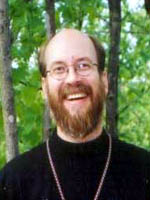
Message from Fr. Robert |


2012 Lenten Services(.doc)
Regular Schedule
Great Vespers: Saturday, 5 PM
Church School: Sunday, 9 AM
Choir Rehearsal: Sunday, 9 AM
Divine Liturgy: Sunday, 10 AM
Summer Schedule
Great Vespers: Saturday, 5 PM
Divine Liturgy: Sunday, 9:30AM
Feast Days
Vespers: 6:30 PM
Liturgy: 9:30 AM
![]() |
Message from Fr. Robert |
Lenten Thoughts - 2010 |
|
for as the Prodigal I have wasted my life. In the unfailing wealth of your mercy, O Savior, reject not my heart in its poverty. For with compunction I cry to You, O Lord: Father I have sinned against heaven and before You. (Sedalen, Matins, Sunday of the Prodigal Son) |
|
In our youth, freedom seemed like the most desirable quality of life. We couldn’t wait to move away from home, make our way in the world, a way that we would pave, a way that would be different from the one paved by our parents. Freedom from all that constrained us was our heart’s desire. So, too, with the younger son in the Parable of the Prodigal or Lost Son. He couldn’t wait to be free of the suffocating presence of family, community and culture. So urgent was his desire that he demanded his release from his father by asking for his inheritance now and in cash, not land as was the custom. The custom had been for the father to divide his lands among his sons and for his sons to support their father by working the land given to them. For generations, social and communal interactions had been preserved and strengthened through this time-honored tradition. Sadly, youth does not always seek wisdom. For the younger son, tradition was stifling. Thus, in his folly, he demanded what was his so that he would finally be free to pursue his life as he best saw fit as far away from his former existence as the world would allow. Our lives don’t always work out the way we envision. Oh, initially, the younger son basked in the glow of his self-acclaimed wisdom. Everything was working according to plan, MY plan, he thought, and I’m so glad that I am free of my Father. Isn’t it ironic that just when we think matters couldn’t be better, something happens to remind us of the precariousness of our existence and the folly of our delusion. For the younger son, the money ran out just as a famine arose in the land. Being far from home, he became the slave of a foreigner, was sent to tend swine, but was given nothing to eat, not even the swine’s leavings. In short, he had forsaken his true identity for an illusion. Just when he thought that hope had set sail for a more distant land and his life was about to come to a bad end, he came to himself. He realized that life with his Father was not as stifling as he thought. Heck, even the slaves were fed and treated well. Since in his mind there was no way his Father would receive him back after what such an ungrateful son had done, the son seeks to return, confess his error and be received by his Father, not as a son, but as a SLAVE. Surely slavery in his Father’s house must be better than freedom to starve in a foreign land. The son underestimates the Father’s love. While the son is still far off and before he can utter a word, the Father rushes to meet him, kisses him, orders the royal robe to be placed on his shoulders, the ring of kingship on his finger, sandals on his feet and the fatted calf to be slain so that the entire household may make merry for the one lost has been found, the one dead is alive. For true love forgives. To us, the Prodigal Son must be the model of repentance. When we sin, we demand our own. We demand our freedom from obedience to anyone for any reason. We reject even the all-embracing love of our Father in heaven. Repentance is a coming to ourselves, a realization that freedom carries with it responsibility. As human beings, we have been endowed with free will and this freedom makes us unique and most precious out of all creation. Yet, true freedom, and thus, true humanity is possible only in our Father’s house. For in our Father’s house, we are given all that we need to mature in just relationship with God, neighbor, creation and self. Outside of our Father’s house, these relationships become distorted and misshapen, but inside, they are made perfect through the divine love that forms, nourishes and completes everyone who enters the world. It would be easy to stop now, but in this parable, we are presented with one more son—the elder. He is the good son, the one who never leaves his Father, never disowns his parents, culture or land. His response to his brother’s return should be the same as the Father’s, yet it is not. The elder son is consumed by jealousy, by a sense of affront. He is hurt. He never left his Father’s house, yet, not once did his Father ever treat him and his friends to such festivities. In the eyes of the elder, the younger son is unworthy of the Father’s love for the younger has not EARNED it like the elder one has done. The younger son was feckless, faithless while the elder was steadfast. Certainly, he thinks to himself, I am more worthy than my younger brother of such a celebration. In spite of the Father’s entreaties that the elder has always shared in everything and that he should come and join in the celebration of his brother’s return for the one lost has been found, the one dead is alive, the elder brother remains at the threshold. The error of the elder brother is that since he alone maintained a steadfast presence in his Father’s house, he thinks that he is alone entitled to the Father’s love. He feels that he has at least earned that much from his Father. While the younger son lacks the wisdom that tempers freedom, the elder lacks the humility that tempers steadfastness. We become the same as the elder when we believe that because we faithfully participate in parish activities and follow all the “rules,” we deserve God’s love and others do not. We forget that it does not belong to us, but to our Father and that in and through his love we have access to all that is his. It is in humility that we rejoice and not criticize at the return of the lost, that we love as we are loved and not condemn the found for their shortcomings. In the Great Fast, freedom is tempered by wisdom and steadfastness by humility. We learn how to receive the Father’s love and share that love with all we encounter. Through repentance, we enter into our Father’s joy and experience and manifest the glory of his house. Let us not sit idle while Great Lent passes, but enter more fully into the love that is stronger than death, into the Kingdom that cannot be overthrown through a repentance rooted in humility and knowledge of God. |
A few words about abstinence. |
| First, why do we abstain? Abstinence is part of the ascetic life together with prayer, both corporate and personal, and almsgiving or charity. Abstinence as an act independent of the other two actions is merely a diet, one that is doomed to failure. In its proper context, abstinence reminds us that, if we are what we eat as Fr. Schmemann contends, Christians by partaking of the divine Body and Blood of Christ are alive in Christ and He in us. The only way we can perceive this life in Christ as living and life-giving is by freeing ourselves from bondage to the world. Abstinence is that vehicle or way to freedom. Therefore, in practical terms, how do we abstain? As regards the practical, we must discern the two dimensions of abstinence: the letter and the spirit. The letter is pretty clear: no meat or dairy is permitted at any meal during the Great Fast with fish being allowed at Annunciation as the only exception. Furthermore, we are encouraged to practice xerophagy or dry eating on Mondays, Wednesdays and Fridays. This is relaxed on all other days with wine and oil being permitted. Not too much to remember, right? The spirit is also clear: the purpose of all of this denial is to lead us into deeper union and communion with God. Pretty straightforward, right? Well, practically speaking, NO! Too often, rigid adherence to the former leads to the death of the latter. So, what are we to do? In practical terms we do what we can and then we try to do a little more. We cannot be liberated from an earthly slavery without a little effort on our part, a response if you will, to the crucified and risen Lord who suffered and gave his life for us so that we may have life unending in his Name. It should be difficult. It should provoke a positive response. Thus, if the response is the opposite of that desired, instead of drawing closer to God we move further away, then something is out of balance. It profits us little if all this abstinence makes us ornery, depressed, irritated, ill and ill-tempered. If this is the case, then maybe we need to rethink the way we are fasting. Beware! If we become homicidal or suicidal in the fourth week of the Great Fast, then we are either ignoring prayer or almsgiving or both. Before we take our frustrations out on God, ourselves, and our neighbor, best to have a cheeseburger to restore our good humor. If we are suffering greatly, then we need to moderate the fast. I leave it to you to decide how. Beware! If you are under a physician’s care and need to eat certain food groups or eat at regular intervals or take medication with food, follow your physician’s instructions. I’m not eager for more hospital visits or funerals. Doctor’s orders, however, should not be a ready excuse to park ourselves in front of a seven course meal. As far as abstaining for evening liturgies, I offer three possible courses of action: to fast from midnight before, to partake of a Lenten breakfast and fast the rest of the day or to partake of a Lenten breakfast and light Lenten lunch and fast until liturgy. I leave it to you to decide what is best. Parents: If you have children who express an interest in joining you in fasting, see what you can do. If it is simply driving you (and them) crazy, try offering a cheeseburger. Above all, if we do not attend any of the midweek Lenten services, all of this effort will be a waste of time and energy. This is not an invitation to skip it completely, but to make a good faith effort. Nothing ventured, nothing gained. The rewards are great, but effort is required. |